
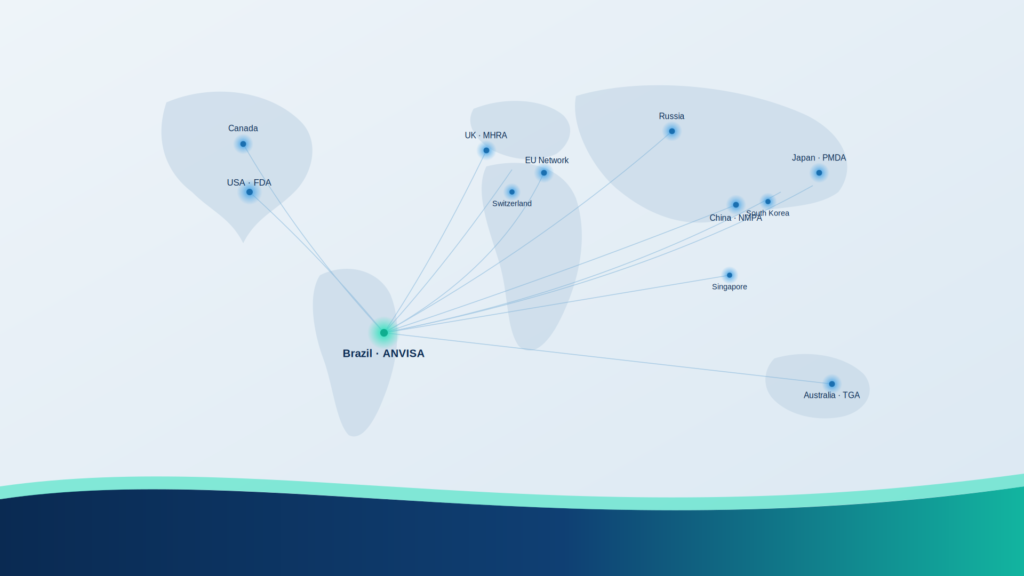
On July 14, 2026, the World Health Organization published its first list of transitional WHO Listed Authorities for medical devices — tWLA-MD, in WHO’s shorthand. Twelve regulatory authorities made the list. Brazil’s ANVISA is one of them, alongside the US FDA, Health Canada, Australia’s TGA, Japan’s PMDA, the UK’s MHRA, and the European medical devices network.
If you manufacture, import, or distribute medical devices in the US and have never dealt with ANVISA, this is worth five minutes of your attention — not because it changes your regulatory obligations today, but because it changes the assumption a lot of US companies carry into their first conversation about Brazil.
What actually happened
WHO has been moving away from the older concept of “Stringent Regulatory Authorities” (SRAs) — a designation that historically included the usual short list: FDA, EMA, Health Canada, TGA, and a handful of others. The replacement framework, WHO Listed Authorities (WLA), is meant to be more transparent and performance-based, evaluated against WHO’s own criteria rather than inherited reputation.
Medical devices got their own list — separate from the WHO’s longer-standing medicines and vaccines lists — for the first time in July 2026. WHO built the medical-device list from two existing signals: authorities already recognized through WHO’s Prequalification program for medical devices, and authorities holding a Management Committee seat at the International Medical Device Regulators Forum (IMDRF). ANVISA holds both.
The full list, as of July 1, 2026:
- Australia — Therapeutic Goods Administration (TGA)
- Brazil — ANVISA
- Canada — Health Canada
- China — National Medical Products Administration (NMPA)
- European Medical Devices Regulatory Network (European Commission + EU/EEA-EFTA member state authorities)
- Japan — MHLW/PMDA
- Republic of Korea — MFDS
- Russian Federation — Ministry of Health
- Singapore — Health Sciences Authority (HSA)
- Switzerland — Swissmedic
- United Kingdom — MHRA
- United States — FDA
Twelve authorities, worldwide, for the entire category of medical devices and IVDs. ANVISA is on it. That’s the fact worth sitting with if your mental model of Brazil’s regulator is “slower, less rigorous, developing-market agency.”
What “transitional” actually means — and what it doesn’t
The designation is explicitly interim. WHO is still finalizing the full performance-evaluation pathway for medical devices, and the transitional list exists as a bridge while that process is built out. ANVISA has not been independently re-audited against a new WLA standard yet — it was placed on the list based on its existing WHO Prequalification recognition and IMDRF membership. The list itself says as much: authorities move from “transitional” to permanent WLA status only after completing that evaluation.
So this isn’t a claim that ANVISA review will suddenly be faster, or that a Brazilian registration now substitutes for FDA clearance, or that RDC 751 classification rules have changed. None of that is true, and no one should tell you otherwise. What it is: a formal, WHO-published signal that Brazil’s regulatory oversight of devices is now grouped with the FDA’s, not against it.
Why that distinction matters in practice
The underlying idea behind WLA — WHO calls it “regulatory reliance” — is that regulators in other countries can lean on a WLA-listed authority’s decisions instead of repeating the same technical review independently. That’s the actual mechanism, not a symbolic gesture: it lets under-resourced regulators shortcut redundant work by pointing to an ANVISA approval as evidence of a credible prior review. For a US manufacturer thinking about market sequencing, that has one direct implication worth noting: an ANVISA registration is starting to carry weight beyond Brazil’s borders, in the countries that build reliance pathways around WLA-listed authorities. It doesn’t replace registering separately where required, but it changes how a Brazilian filing gets treated elsewhere in Latin America and beyond.
The timing also lines up with operational changes already underway inside ANVISA. Over the past year the agency has introduced task forces for backlog reduction, automated approval routes for lower-risk device classes, and a shift toward risk-based inspection — moves aimed squarely at the approval-queue delays that have been the most common US-manufacturer complaint about entering Brazil. The WHO listing and the internal reform aren’t the same announcement, but they point the same direction: an agency actively working to be taken more seriously by the international system it’s now formally part of.
What this doesn’t change
To be direct about the limits: your device’s classification under RDC 751 doesn’t shift because of this listing. Labeling, IFU, and technical documentation requirements are unchanged. Registration timelines are still governed by ANVISA’s existing processing rules, and the transitional designation carries no guarantee about how quickly your specific dossier moves. A WHO list entry improves the credibility case for treating Brazil as a serious market — it does not substitute for the dossier work itself.
The practical takeaway
If Brazil has been sitting on your “someday” list of markets — behind the EU, behind Canada, behind wherever felt lower-risk — this is a reasonable moment to move it up the list for evaluation, not because the paperwork got easier, but because the regulator now sits in the same WHO category as the one you already answer to. The underlying registration process — RDC 751 classification, technical file review, RT designation, INMETRO and ANATEL requirements where applicable — is unchanged and still requires the same care any first market entry does.
AVRA works from the classification stage through registration, RT designation, and downstream INMETRO/ANATEL requirements for US manufacturers entering Brazil and the wider LATAM market. If you’re weighing whether now is the right time to start, a free 30-minute scoping call is the fastest way to find out what your specific device would need.
Sources: World Health Organization, “WHO advances global regulatory cooperation with first interim list of regulatory authorities for medical devices,” July 23, 2026; WHO, “List of transitional WHO Listed Authorities for medical devices,” July 14, 2026.